
From AI Potential to Enterprise Value: Why combining AI Engineering with Process Intelligence can turn isolated innovation into measurable and lasting enterprise value

For many organisations, identifying promising AI opportunities and proving their technical feasibility are no longer the biggest hurdles. The real test is turning that potential into measurable, sustainable business value.
Enterprises are investing in AI platforms, copilots, bespoke AI solutions and automation. Yet the outcomes remain uneven. Solutions are built but not adopted. Insights are generated but do not change decisions. Automations are deployed but fail to scale. Promising experiments struggle to make the transition into the day-to-day operation of the business.
This points to an important truth: AI alone does not transform an organisation.
AI creates value when it improves how work is performed, how decisions are made and how customers or employees experience a process. Achieving that requires more than models and technology. It requires evidence about where value is being lost, engineering capabilities that can create a practical intervention, and the organisational conditions that allow the resulting change to take hold.
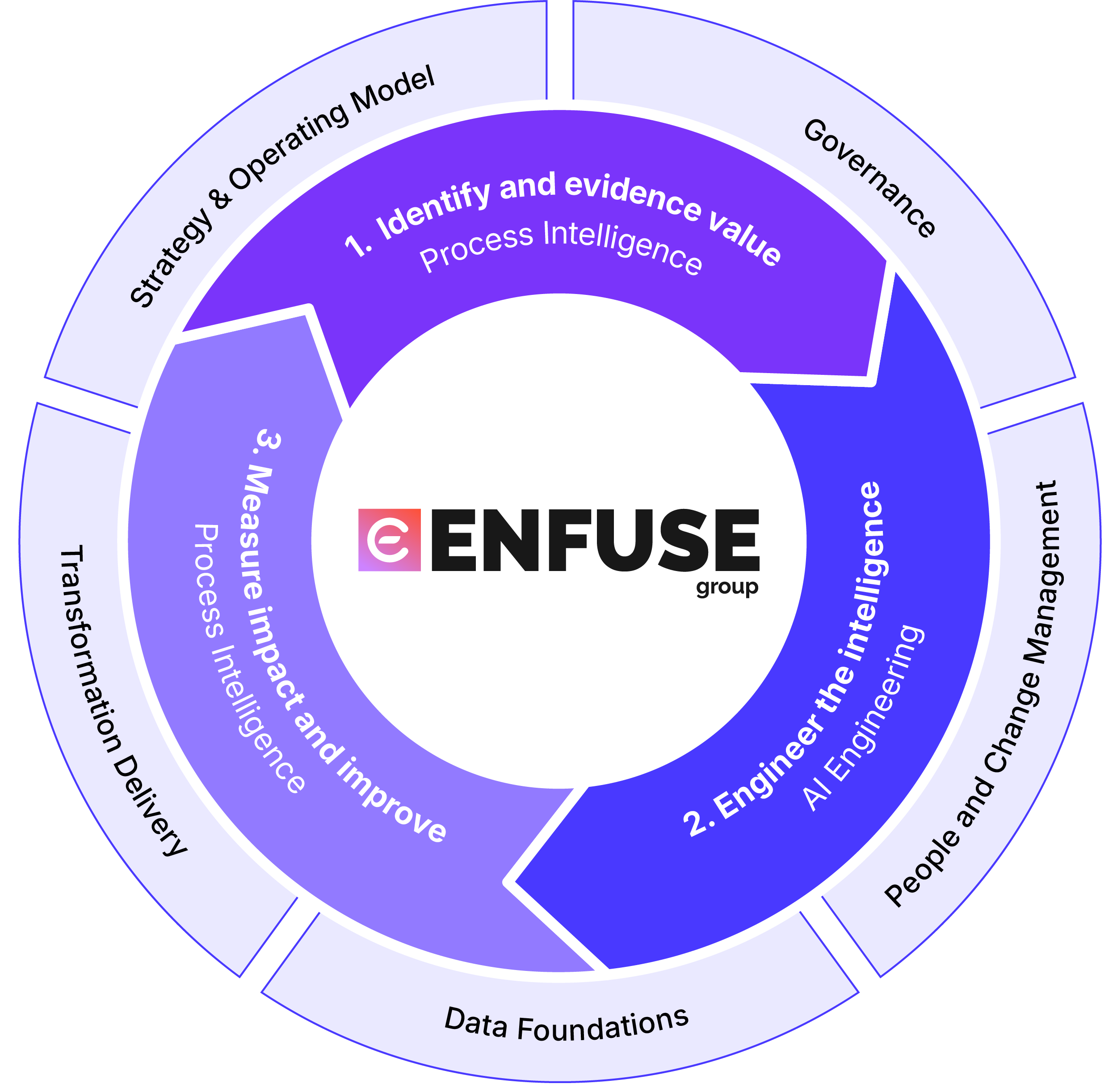
At Enfuse, our view is that AI Engineering and Process Intelligence can provide this connection. Together, they create a continuous value loop:
- Process Intelligence identifies and evidences the opportunity.
- AI Engineering creates the intelligent intervention.
- Process Intelligence measures the impact and identifies the next opportunity.
Pragmatic data foundations, operating model, governance, people and change, and transformation delivery provide the conditions that allow this loop to operate at enterprise scale.
The AI value gap is an operational challenge
Investments in data platforms, AI models, cloud infrastructure and automation are often necessary. But they only address part of the challenge.
AI can produce predictions, recommendations, content and automated actions. These are outputs. They create value only when they improve an operational outcome, such as reducing resolution times, avoiding revenue leakage, improving customer retention, accelerating delivery or enabling employees to make better decisions.
The question often asked is:
Can we build an AI solution?
The more valuable questions are:
How will this solution change the way work is performed or decisions are made?
How will we know that the change has produced a better business outcome?
Answering those questions requires a detailed understanding of how the organisation actually operates.
Identifying and evidencing the opportunities
AI discovery often relies heavily on stakeholder workshops, interviews and brainstorming. These approaches remain important because they reveal strategic priorities, pain points and frontline experience.
However, they can be strengthened by Process Intelligence.
Process mining, task mining, operational analytics and performance intelligence use the data generated through business activity to build an evidence-led view of how work is really performed. This can help organisations understand:
- How processes flow across teams, systems and organisational boundaries
- Where delays, bottlenecks and hand-offs occur
- Where manual effort is concentrated
- Which decisions or exceptions create rework
- Where process variation affects cost, quality or customer experience
- Which operational constraints limit growth or service performance
This does more than produce another list of potential use cases. It helps leaders quantify the scale of a problem, establish a baseline and understand which interventions are likely to matter most.
Operational evidence can also test organisational assumptions. A perceived problem may prove to be less significant than expected. A previously hidden source of delay or failure may emerge as a more valuable target. Data does not replace business judgement, but it gives leaders a stronger basis on which to apply it.
The depth of insight available will depend on the quality and coverage of operational data, so process evidence should be augmented with frontline knowledge and business judgement, as relevant. The result is not simply an opportunity to improve a process. It is a more informed view of where AI could make a material difference and what success should look like.
Engineering intelligence around the work
Once worthwhile opportunities have been identified and prioritised, AI Engineering provides the capabilities needed to turn them into safe, scalable and usable solutions.
Depending on the problem, this can bring together:
- Trusted data platforms and reusable data products
- Generative and agentic AI solutions
- Machine learning and predictive analytics
- Integration and orchestration
- Data quality, governance and observability
- AI security, compliance and performance monitoring
The objective is not to deploy every component, but to engineer the optimal combination for the outcome being pursued. A technically sophisticated solution is not automatically a valuable one. Enterprise AI must operate within real processes, use appropriate data, connect to existing systems and provide its outputs at the point where a person or system can act upon them. AI might predict customer churn, recommend the next action in a service interaction, identify emerging supply chain disruption, produce a draft contingency plan, generate a project plan from unstructured information or automate a routine operational decision. But each of these remains just an AI output until it translates to an operational outcome.
Measuring and improving operational outcomes
This is where Process Intelligence returns to the value loop.
The same process evidence that helped identify the opportunity can be used to assess whether performance improved following the AI-enabled intervention and whether the evidence reasonably supports a connection between the two. Rather than measuring success through deployment, availability or model accuracy alone, organisations can examine whether the process itself improved.
For example:
- Did cycle time reduce?
- Did avoidable rework decline?
- Did customer outcomes improve?
- Did employees spend less time on low-value activity?
- Did the quality and consistency of decisions increase?
- Were benefits realised across the operation or only within a limited pilot?
This creates a continuous feedback loop. Operational evidence guides AI investment. AI changes how work is performed. New process and performance data then shows whether the change created value and where further improvement is possible.
In this model, Process Intelligence is not merely a discovery tool, and AI is not a standalone technical solution. Together, they form a mechanism for continuous, evidence-led transformation.
Bringing the value loop to life
Consider a customer service operation.
Process Intelligence might reveal that complaint resolution is being delayed because advisers spend significant time gathering customer information from multiple systems. It can show where the delay occurs, quantify its effect on resolution times and repeat contact, and establish a baseline against which improvement can be measured.
AI Engineering can then create an intelligent solution that assembles relevant customer context, recommends possible actions and generates a draft response for the adviser to review.
The organisation can subsequently use Process Intelligence to determine whether the intervention reduced information-gathering time, accelerated resolution, improved consistency and improved the wider customer journey and end-customer experience.
The solution creates value because it addresses an evidenced operational constraint and changes how work is performed. Its success is judged by the outcome it produces, not simply by whether the AI performs its technical function.
The same principle can apply across procurement, supply chain, finance, human resources, project delivery and other critical enterprise processes.
AI technology is only part of the transformation
Even an evidenced opportunity and a well-engineered AI solution are not enough. As AI becomes embedded in enterprise processes, it changes roles, responsibilities, decisions, controls and ways of working. Organisations therefore need an operating environment in which people, processes, data and AI can function together effectively.
Five capabilities are particularly important.
1. Pragmatic data foundations that enable value
AI solutions depend on data that is sufficiently accessible, reliable, understood and governed for the intended use. But this does not mean organisations must resolve every data issue or spend years building a comprehensive enterprise data platform before seeing any value.
The pragmatic approach is to work backwards from priority AI opportunities. For each opportunity, organisations should identify the data required, assess whether it is fit for purpose and address the specific gaps that would prevent the solution from operating safely and effectively.
This might involve improving a critical dataset, creating a dependable connection to a source system, clarifying ownership and definitions, applying appropriate access controls or monitoring the data and AI outputs.
Where practical, these improvements should be designed for reuse. Each use case can then strengthen the organisation’s wider data foundations without making a large, multi-year data transformation a prerequisite for progress.
The goal is not perfect data. It is trusted, usable and appropriately governed data for the opportunities that matter now, with each intervention strengthening the foundations for what comes next.
2. An operating model that enables AI at scale
AI can support decisions and automate or augment work, but accountability for business outcomes must remain clear. Organisations need to decide where automation is appropriate, where AI should support people, and where human judgement and ownership must be retained.
Scaling AI also requires clarity on the capabilities needed, what should be owned centrally versus within business areas, and how business, data, technology, risk and change teams work together. The operating model should establish how opportunities are funded and prioritised, how cross-functional dependencies are resolved, and who owns processes, data, AI solutions, controls and benefits throughout their lifecycle.
Without thisclarity, pilots multiply, capabilities become fragmented and responsibility forrealising value remains unclear.
3. Governance that enables responsible progress
Governance should not be treated as a final approval stage gate or a brake on innovation. It should help teams move forward confidently within clear boundaries and remain embedded throughout the AI lifecycle, from use-case selection and design through to deployment, monitoring and decommissioning.
Governance should be proportionate to the use cases and include clear expectations, controls, metrics and escalation routes when performance, risk, cost or operating context changes. For AI agents, this may mean continuously monitoring actions, outcomes, costs and exceptions, and using those insights to optimise controls and improve performance over time.
Done well, governance creates a continuous feedback loop that enables responsible innovation without unnecessarily slowing delivery.
4. People and change management that reshape behaviour
Deploying an AI solution is a milestone. Transforming how an organisation works, and embedding that change into business as usual, is the destination.
The people response must extend beyond solution training. AI can change the balance of activities within roles, introduce new capabilities and responsibilities, reshape career paths and affect workforce capacity and demand. Organisations therefore need role-based capability building, job and workflow redesign, and a clear employee value proposition that explains how human expertise and AI will work together.
Sustainable adoption also requires a culture in which people can experiment responsibly, question AI outputs, share learning and report failures or bias without fear. Leaders must model these behaviours and create the space and psychological safety to test, learn and improve, while aligning the change with the organisation’s wider culture and strategy.
Adoption should be measured through behaviours and outcomes, not simply access, training or usage. Performance measures, objectives, incentives, leadership routines, governance and workload must reinforce the new ways of working. Otherwise, even willing and capable employees may be pulled back towards established priorities and habits.
5.Transformation delivery that connects change to value
AI initiatives must operate within the realities of enterprise transformation. Data dependencies, system integration, process redesign, governance, workforce readiness and benefit realisation need to be managed as one coherent change.
Effective transformation delivery maintains the connection between the original opportunity, the AI engineering solution being developed and the outcome the organisation expects to achieve. It enables organisations to test assumptions, deliver incrementally, manage dependencies and adapt when the evidence changes.
This is what moves AI beyond a collection of promising experiments and turns it into a repeatable capability for enterprise improvement.
A smarter organisation, not simply smarter technology
The next generation of leading organisations will not be defined by the number of AI models, agents or copilots they deploy. Rather, they will be defined by how effectively they combine human intelligence, artificial intelligence and operational evidence to make better decisions and improve execution.
AI Engineering creates the intelligent capability.
Process Intelligence identifies where that capability can matter and determines whether it has made a difference.
Pragmatic data foundations provide the trusted, usable data needed to enable priority opportunities.
Operating model and governance establish accountability and trust.
People and change management embed new behaviours and ways of working.
Transformation delivery connects the intervention to measurable outcomes.
When these disciplines operate together, organisations can move beyond isolated AI experiments and establish a repeatable mechanism for finding, creating and sustaining value.
The outcome is not simply smarter technology. It is a more intelligent organisation.
Intelligence with purpose
At Enfuse, our expertise spans Process Intelligence, Data and AI Engineering, Strategy and Operating Model, and Transformation Delivery. We help organisations connect people, process, data, technology and AI to make better decisions, adapt faster and create lasting value. Bringing these capabilities together under one roof allows us to help clients identify and evidence where value exists, engineer the intelligence needed to unlock it, establish the operating environment and governance required to sustain it, and deliver the change through to measurable outcomes.
Because intelligence creates value only when it is applied with purpose.
Talk to us at Enfuse about how to turn operational evidence into intelligence, intelligence into action, and action into lasting business value.

Related posts
Dive in more with our related insights.