
We predicted the future of digital transformation. Here's what we got right and wrong.

Last year, Enfuse Group partnered with Retail Economics to publish The 18% Advantage, exploring the forces shaping digital transformation across Retail & Hospitality and how different organisations were responding to this based upon their level of maturity. The research involved crunching a lot of data, supplemented by insights from over 100 senior sector leaders, the report identified 7 pillars that would define transformation over the coming years.
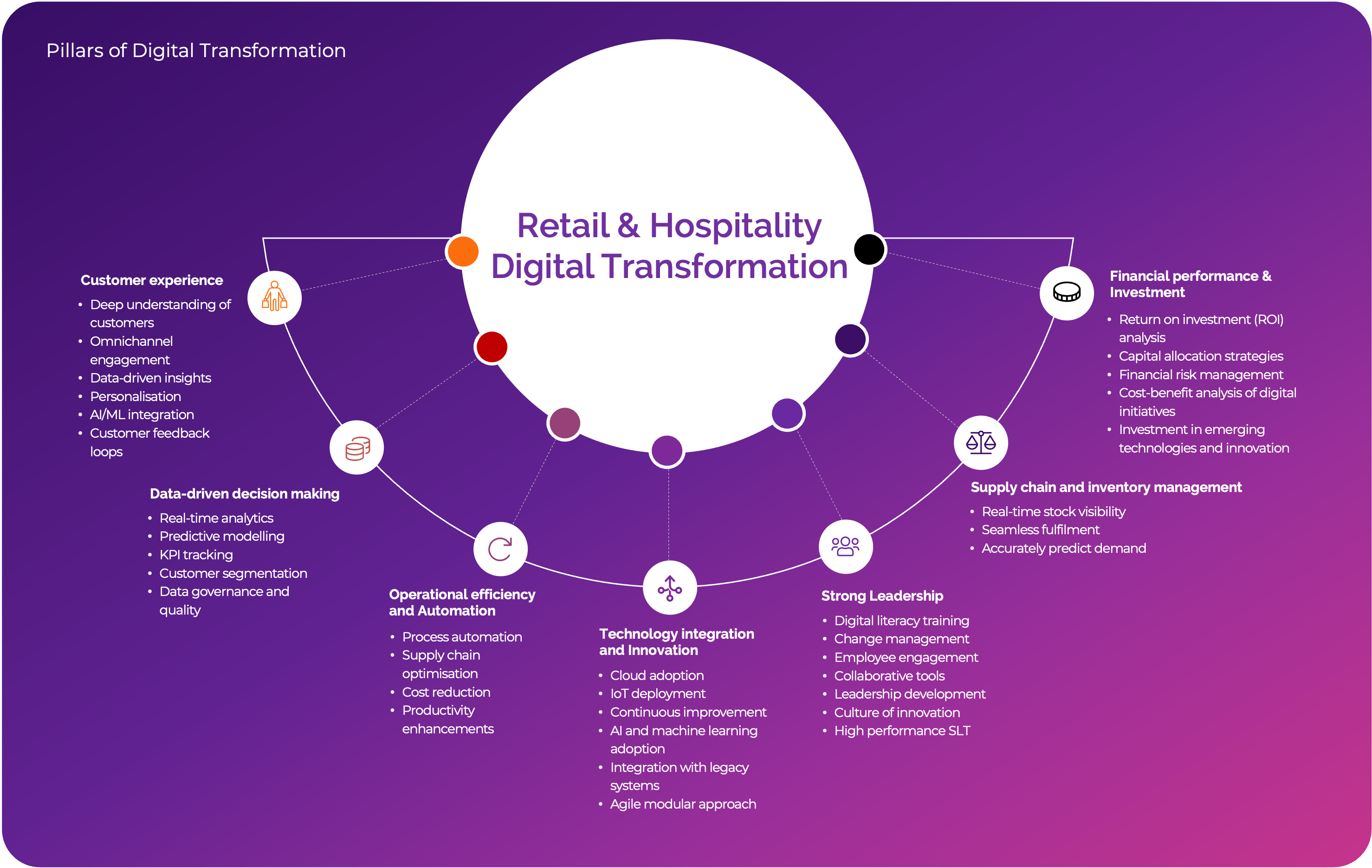
12 months later, having supported retailers, hospitality brands and growth businesses to navigate their own journeys we wanted to revisit our predictions.
Some proved remarkably accurate whilst others evolved faster than we expected and a few things we simply didn't see coming.
This reflection also helps us to think about what 2027 looks like for the sector. Here’s what we found.
What we got right – operational efficiency became the boardroom priority
In our report, operational efficiency and automation emerged as one of the primary motivations for digital transformation. Rising labour costs, increasing tax pressures and the need to improve productivity were already influencing investment decisions.
We calculated that 50% of digital transformation initiatives would be driven by operational efficiency. That prediction proved spot on.
Across almost every engagement we've supported this year, organisations have focused on doing more with what they already have. Whether improving Drive-Thru operations, ‘sweating’ technology assets rather than replacing them, going “back to basics” with mapping critical processes to reduce errors and manual processes. Transformation initiatives have increasingly been measured through the lens of how to drive operational performance.
The conversation has shifted from "What's the next piece of technology or feature?" to "Where can technology remove friction and create capacity?"
That feels like a significant change in mindset.
What we got right: AI adoption requires more than technology
One of the most striking findings in the report was that limited training and knowledge represented one of the biggest barriers to successful transformation, particularly amongst organisations at the start of their journey. A whopping 56% of respondents stated that this was the #1 issue.
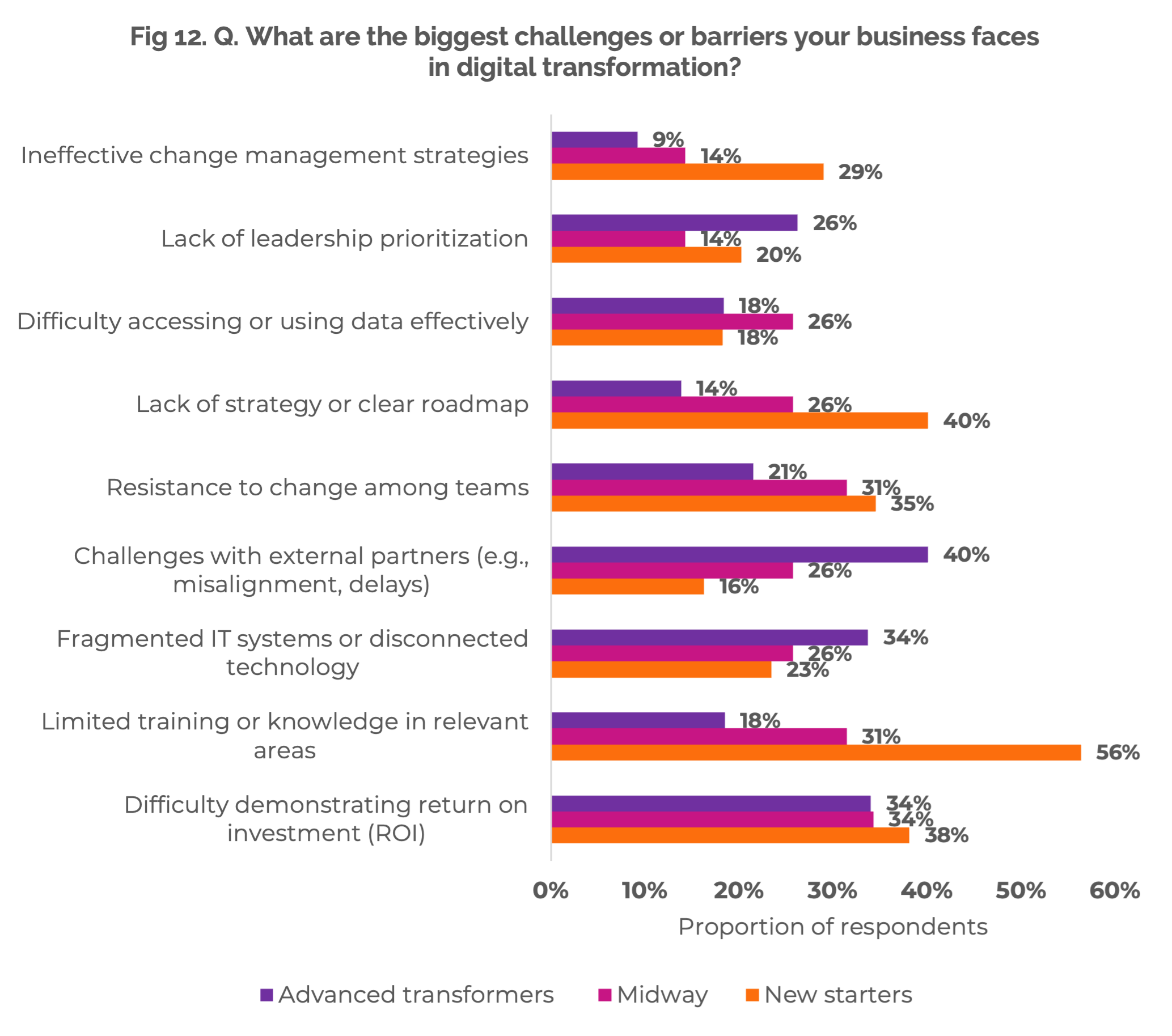
If anything, this challenge has become even more relevant.
Over the past year, we've seen growing demand for AI education, leadership workshops, use-case identification sessions and transformation readiness assessments. Leaders aren't simply asking how AI works. They're asking how to adopt it responsibly, where value can genuinely be created and how their people need to adapt.
AI literacy is no longer a nice-to-have. It's becoming a prerequisite for transformation success and, as such, part of the work we are doing with our clients.
What we got right (to an extent): data-driven decision-making matters more than ever
The report identified data-driven decision-making as a key differentiator for digitally mature organisations. Advanced transformers consistently prioritised data and analytics over short-term cost reduction. That trend remains absolutely true.
However, what we've learnt during 2026 is that our clients aren’t coming to us specifically about analytics, but rather about:
- Data quality.
- Connectivity.
- Fragmented architecture.
- Inconsistent definitions.
Many businesses have invested heavily in reporting platforms, dashboards and AI tooling. Yet the underlying data foundations often remain weak.
If there is one lesson we've seen repeatedly this year, it is that AI and automation are only as effective as the data that powers them.
What we underestimated: competitor pressure
Customer expectations emerged as the largest driver of transformation in our research (35%), while competitor pressure ranked at 20%.

Looking back, we underestimated the competitive dynamic.
Many of our conversations with C-suite teams this year have been defensive rather than offensive.
They are asking:
- How do we keep pace with digitally native competitors?
- What happens when a US brand enters our market?
- How do we respond to changing consumer expectations?
- How do we avoid being left behind?
Digital transformation is increasingly becoming a race simply to stay relevant.
For many organisations, standing still is no longer an option.
What we didn't fully anticipate: the unexpected evolution of transformation: confidence before commitment
One area where reality moved faster than the research was around investment models.
The report correctly identified ROI as the biggest challenge facing transformation initiatives.
What we didn't foresee was how organisations would respond.
Rather than launching large-scale programmes immediately, many businesses are opting for:
- AI Proof of Concepts
- Discovery engagements
- Innovation workshops
- Rapid assessments
The objective isn't to avoid transformation. It's to reduce uncertainty.
We've seen organisations gain value from a single workshop, establish a roadmap in a matter of weeks and build confidence before committing to larger investment decisions.
Transformation is becoming more iterative, more evidence-led and significantly less risky.
What we got wrong: the investment divide
One of our most interesting findings suggested that mature organisations would continue to significantly outspend businesses earlier in their transformation journey.
Technically, that remains true.
But our experience this year suggests the picture is more nuanced.
Many organisations at the start or in the middle of their transformation journey are now investing earlier and more strategically than we expected. They have seen the challenges encountered by mature businesses and are actively trying to avoid repeating them.
Rather than "grow first and optimise later," we're seeing greater emphasis on:
- Scalable operating models
- Digital readiness
- Data foundations
- Architecture simplification
- Stronger governance
The size of the opportunity is simply too large to ignore.
As a result, some of the most ambitious work we've had this year has come from organisations that are only just beginning their transformation journey.
The biggest lesson from 2026
Perhaps the most important conclusion is that the fundamentals haven't changed.
- Strong leadership still matters.
- Data still matters.
- Operational efficiency still matters.
- Culture still matters.
What has changed is the speed.
AI has accelerated expectations. Competitive pressure has intensified. Investment decisions are under greater scrutiny. And organisations are increasingly looking for tangible business outcomes rather than transformation for transformation's sake.
Looking back, the biggest surprise wasn't that our predictions were wrong. It was how quickly they became reality and evolved.
If you missed the original report and would like a copy, drop us a message via hello@enfusegroup.com

Related posts
Dive in more with our related insights.