
Agile ERP process modelling

CLIENT
Footwear Retail Client
ABOUT THE PROJECT
Our client was a footwear company with ambitious plans for significant growth over the next five years, who needed for a core system upgrade in order to take advantage of a new, streamlined ERP. Their process environment was highly immature, with little governance, documentation and general understanding of ways of working across departmental siloes, resulting from a notably outdated and highly customised ERP system. Previous ERP upgrade attempts were unsuccessful due to poor understanding of how the current ERP was used to execute business-critical processes.
THE CHALLENGE
The immature process capability at the client, combined with a lack of process management had led to incomplete processes, resulting in information gaps and ambiguity in roles, responsibilities, and system touch points. Additionally, process SMEs had limited capacity due to constant firefighting of issues. If a handover from Enfuse to the client was not comprehensive, there was a risk of this project losing momentum, potentially causing delays in the ERP upgrade, or even leading to an improper system implementation.
THE ENFUSE APPROACH
This project was structured in an agile format consisting of three, two-week sprints, with an emphasis on modelling the most system-intensive processes while minimising time required from stakeholders. Our approach was as follows:
- Create and refine a list of best practice End-to-End (E2E) processes, based on our experience and industry best practice. This list was refined with the business through a kick off workshop to ensure our scope was comprehensive and reflective of their business.
- Review the process list with the sponsor. We identified SMEs for each process, agreed information capture requirements and prioritised these processes based on which needed to be modelled first. Processes which were unique, had many interactions with the ERP system and were only well understood by a handful of people in the business got high priority.
- We held separate kick-off and review sessions with the relevant SME where we drafted the process with the SME, added the key process details to meet our defined modelling requirements before following up with a review session to make final edits and obtain SME approval. Sessions were recorded to minimise time needed with key stakeholders.
- Transfer knowledge - At the end of the project, we booked in knowledge transfer sessions with nominated representatives from the client to explain each deliverable, train these employees in BPMN literacy and outline a roadmap for next steps.
[caption id="" align="alignnone" width="1802"]

1.1 Example of a drafted process (Client-specific information removed) [/caption] [caption id="" align="alignnone" width="2191"]
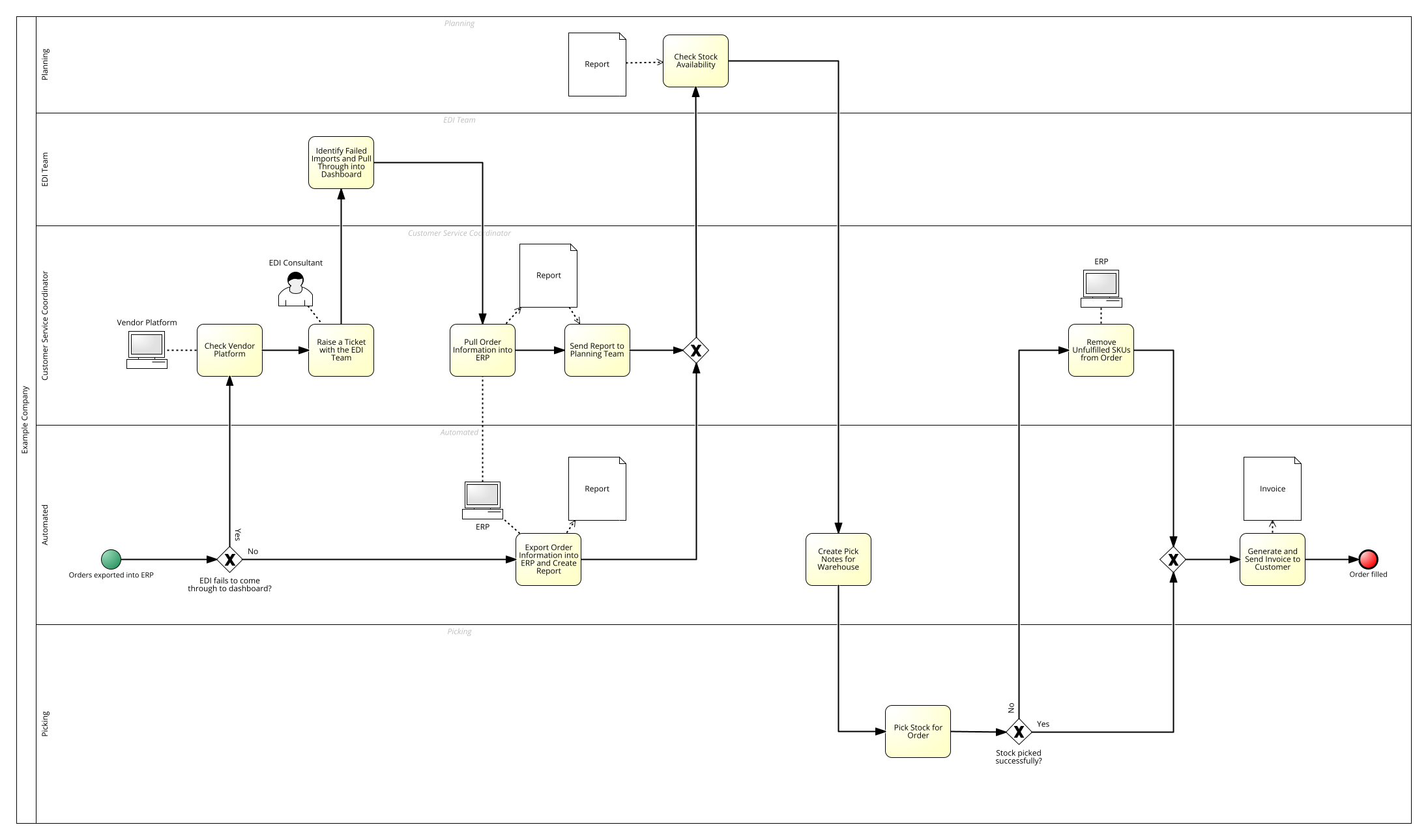
1.2 Example of a completed process (Client-specific information removed) [/caption]
THE OUTCOMES
At the end of the six weeks, we modelled 45 processes to consistent BPMN 2.0 standard and the client’s modelling requirements. We handed over three deliverables for each process:
- A high-definition PDF of each process
- An editable copy of a detailed process report for each process – This allowed the client to access all of the information we captured using our modelling software, without them requiring licenses themselves
- A BPMN file format copy of the process. This would allow the client to edit the process should they purchase modelling software in future.
As a value-adding additional deliverable, we also provided a 'pain-points tracker' as part of our handover. This described the challenges faced by SMEs, allowing the executive team to understand the root causes of challenges and provide a starting point of understanding the business requirements for a new ERP system. The combined result of these outputs meant that the client had a launchpad to kickstart their process modelling efforts and make sure they understood their ways of working before attempting another ERP upgrade.

Related posts
Dive in more with our related insights.

.png)
.png)